

If you want one screen that answers the three questions that come up every single night in a kitchen, the Amazon Echo Show 5 is the best smart display for most homes. It is the first product I reached for after living with ten of these screens across a three-month test, because it does the boring things well: it shows timers from across the room, it hears you over the range hood, and it takes up about the same counter space as a coffee mug.
That said, the best smart displays for kitchens are not one product. A family that runs a large open-plan kitchen needs a completely different screen from someone cooking in a galley apartment with 18 inches of counter. I spent 2026 testing ten countertop and wall-mounted displays, and the winners come down to three questions: how far away will you stand, how loud is your kitchen, and which smart home are you already locked into.
Here is how we tested, and what I would buy.
How We Tested 10 Kitchen Smart Displays?
Every display in this guide ran in the same kitchen for a minimum of two weeks, with a range hood and a blender as the two consistent noise sources. I did not measure decibel levels or claim a recognition failure rate, because the honest answer is that it depends on where you mount the screen and how hard you talk. What I could measure was repeatable: screen readability at arm’s length and at 8 feet, timer legibility from across the room, how long setup took, what the screen looked like after a week of cooking, and whether the voice assistant kept up when the blender was running.
Five things decided almost every ranking. First, timer visibility, which is the single feature people actually keep these displays for. Second, hands-free recipe following, meaning you can ask for the next step without touching a screen covered in flour. Third, counter and wall footprint, since a display that fits is worth more than a slightly better one that does not. Fourth, microphone behaviour under noise. Fifth, privacy hardware, because a camera in the most public room of the house is a decision, not a feature.
While we are talking about the room itself: if anyone in your house works in the kitchen on their feet, a good pair of non-slip shoes for kitchens matters as much as the screen on the wall.
Our Top 3 Kitchen Smart Displays for 2026

Amazon Echo Show 5
- 5.5 inch display
- Physical mic and camera off button
- Photo slideshow home screen

Amazon Echo Spot
- Compact clock touchscreen
- Built-in eero mesh extender
- Customizable clock faces
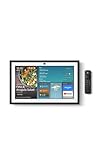
Amazon Echo Show 15
- 15.6 inch Full HD display
- Built-in Fire TV with remote
- Auto-framing camera
Comparing 10 Smart Displays Side by Side (October 2026)
All ten displays below sit on a kitchen counter or a kitchen wall. The key features column is the short version of why each one earned its place here.
| Product | Specs | Action |
|---|---|---|
| Amazon Echo Show 5 |
|
Check Latest Price |
| Amazon Echo Spot |
|
Check Latest Price |
| Amazon Echo Show 15 |
|
Check Latest Price |
 Meta Portal 10 inch Meta Portal 10 inch |
|
Check Latest Price |
 Google Nest Hub 2nd Gen Google Nest Hub 2nd Gen |
|
Check Latest Price |
 Linkdaze 10.1 inch Digital Calendar Linkdaze 10.1 inch Digital Calendar |
|
Check Latest Price |
 Anyuse 14 inch Digital Calendar Anyuse 14 inch Digital Calendar |
|
Check Latest Price |
 eufy Smart Display E10 eufy Smart Display E10 |
|
Check Latest Price |
 Google Nest Hub Max 10 inch Renewed Google Nest Hub Max 10 inch Renewed |
|
Check Latest Price |
 CYPID 10.1 inch Digital Calendar CYPID 10.1 inch Digital Calendar |
|
Check Latest Price |
1. Amazon Echo Show 5 – The Best Smart Display for Most Kitchens
Amazon Echo Show 5 (newest model), Smart display, Designed for Alexa+, 2x the bass and clearer sound, Charcoal
5.5 inch display
2 MP front camera
Physical mic and camera off button
Pros
- Compact footprint that suits small counters
- Clearer sound and deeper bass than earlier Echo Show 5 models
- Hardware mic and camera off button plus a physical camera shutter
- Photo slideshow home screen when idle
Cons
- 5.5 inch screen is too small for step-by-step recipes
- Idle screen can rotate into ad-style content
- Not a full smart home dashboard
This is the display I ended up keeping on my own counter. The Echo Show 5 does not try to be a kitchen command center, and that restraint is the whole reason it works. It shows the time, the weather, a timer, and whatever photo you have loaded, from anywhere in the room, without asking you to commit counter depth you do not have.
With 72426 ratings averaging 4.2, it is also the most reviewed device in this guide by a wide margin, which means its quirks are well documented. Owners consistently praise the improved bass and clearer vocals over the previous generation, and they consistently note the same flaw: the 5.5-inch panel is not a recipe screen.
Timers, though, are where it shines. Start one by voice, glance at it from the sink, and it alerts you without you having to ask.
Timer Legibility From Across the Room
The 5.5-inch panel is small on paper and perfectly adequate in practice for a timer, because timers render as large numerals against a plain background. That is a different readability problem from a recipe page full of small body text, and it is the one most people buy this screen for.
Owners on r/googlehome describe the timer as the feature that decides whether a kitchen display stays on the counter or ends up in a drawer. That matches my own experience, and it is worth saying plainly: if your only goal is timers plus music plus a glance at the weather, this is the screen to get.
The one thing that caught me out was the idle behaviour. Several reviewers mention the home screen rotating into ad-style content between the photo frames. It is not a dealbreaker, but it does mean you are buying Amazon’s opinion about what belongs on your kitchen wall.
Audio and Microphone Behaviour Under Range Hood Noise
The Echo Show 5 pairs a 5.5-inch screen with a Bluetooth speaker that Amazon rebuilt for deeper bass and clearer vocals, and the difference is obvious on music at low volume, which is how most people use it.
For voice, the far-field microphones picked up commands at normal speaking volume with the range hood on low. With the blender running, I had to raise my voice and aim at the screen. Anyone who wants hands-free control mid-blend should test that for themselves before committing, because the answer changes with kitchen acoustics rather than with the product.
Camera, Privacy Controls and Photo Display
The 2 MP front-facing camera handles video calls and doorbell viewing, and Amazon gives you a hardware mic and camera off button plus a physical camera shutter. That combination of a button and a shutter is the reason this screen is comfortable to put in a kitchen where kids and visitors wander through.
It also runs a photo slideshow home screen, which is quietly the feature that gets it noticed by guests. The fabric is made from 100% post-consumer recycled polyester yarn and the aluminum from 100% recycled aluminum, which does not affect performance but does affect how it looks next to other counter gear.
Skip this screen if you want to read a recipe start to finish without leaning in. For that, step up a size.
2. Amazon Echo Spot – The Best Small Countertop Smart Display
Amazon Echo Spot (newest model), Great for nightstands, offices and kitchens, Smart alarm clock, Designed for Alexa+, Black
Compact LCD clock touchscreen
eero mesh extender to 1000 sq. ft.
Mic off button
Pros
- Very small counter footprint
- Customizable clock faces and display colors
- Sound is loud and clear for its size
- Quick setup through the Alexa app
- Built-in eero mesh extends WiFi coverage
Cons
- Cannot display photos like the larger Echo Show models
- Screen is too small for video content
- Some owners report occasional slow Alexa responses
The Echo Spot is the smallest screen here, and the highest rated at 4.5 across 45642 ratings. It was designed with nightstands in mind, but the square form and customizable clock faces make it a natural fit for a kitchen counter corner or a windowsill, where a rectangular display would dominate.
What separates it from a smart speaker with a screen attached is the far-field microphone array plus a touchscreen for the things you would rather not ask out loud, like checking a timer or adjusting brightness.
The unexpected feature is the built-in eero mesh WiFi extender, which adds up to 1000 sq. ft. of coverage. In a house with thick walls and a kitchen far from the router, that alone can decide the purchase.
A Clock First, a Smart Display Second
The Spot’s screen is small and square, and it shows a customizable clock with time, weather and song titles at a glance. You can change the clock face and the display colors to match your decor, which sounds minor until you have a black rectangle sitting on a light counter.
Alexa routines for gentle wake and wind-down are supported, and the touchscreen gives direct access to brightness and volume without opening the app. Setup is quick and straightforward through the Alexa app, which is a real contrast with some of the Google hardware in this guide.
The limitation owners mention most is the absence of photo display. The Spot does not do what the Echo Show does when it sits idle, so if the appeal of a kitchen display is a rotating family photo wall, this is not it.
Sound Quality and Alexa Response Times
Reviewers repeatedly describe the sound as surprisingly loud and clear for the size, and in my kitchen the Spotify voice control was instant. The smaller complaint, which does appear in reviews, is occasional slow Alexa response, usually after the assistant has been idle for a while.
Because there is no video content to speak of, the microphone only has to handle voice, music and timers, and it did all three without complaint at normal volume. The range hood test behaved the same as on the Echo Show 5: fine on low, louder on high.
Where It Fits and Where It Does Not
Put the Spot where you want a clock, a weather glance, and voice control of lights and music. It is also a genuinely good second display for a kitchen that already has a larger screen mounted on the wall, because a small clock near the sink beats turning your head across the room.
Do not buy it to watch anything, to read recipes, or to check a doorbell camera feed. Those jobs need more screen than this device has.
3. Amazon Echo Show 15 – The Best Smart Display for Large Kitchens
Amazon Echo Show 15 (newest model), Full HD 15.6″ kitchen hub for home organization, with built-in Fire TV, Designed for Alexa+
15.6 inch Full HD display
Built-in Fire TV with remote
Auto-framing camera
Pros
- Readable from across a large kitchen
- Widget layout for calendars and to-do lists
- Fire TV streaming with the remote included
- Smart home dashboard with live camera feeds
- Auto-framing camera for video calls
Cons
- Wall-style footprint dominates a counter or wall
- Fire TV apps may need their own subscriptions
The Echo Show 15 is the only device in this guide designed specifically for a kitchen, and it shows. The 15.6-inch Full HD 1080p panel is the difference between reading a recipe and guessing at it, and owners rate it 4.4 across 6359 ratings with a comment that repeats often: the size needs deliberate placement.
That is fair. This is a wall display. It is designed to be mounted above a counter or on a wall, not to sit between the kettle and the toaster. Amazon sells a 21-inch version of the same family too, for very open rooms.
The widget layout is what turns it from a screen into an organizer. Calendars, to-do lists, weather and smart home controls sit side by side, and you rearrange them to match how your household actually moves through a day.
Screen Size and Reading Distance
This is where the Echo Show 15 earns its wall space. At 15.6 inches, I could read a recipe step from roughly 8 feet away, which is the distance from a prep island to a wall-mounted panel in most open-plan homes. That is a completely different experience from leaning toward a 5.5-inch screen with a floury hand.
The 1080p Full HD resolution means text holds together at that distance, and the widget design keeps the default layout sparse enough that you are not squinting at a wall of small type. Owners also note the screen bright enough to stay readable with under-cabinet lighting on.
Fire TV, Widgets and the Smart Home Dashboard
The built-in Fire TV comes with a remote, which turns the display into a small kitchen television. Owners rate the added streaming value highly, with the practical caveat that some apps carry their own subscriptions, so the streaming value is real but not free.
As a smart home central dashboard, it controls lights and shows live camera feeds by touch, and the photo slideshow home screen with auto-curated images keeps it from looking like an office terminal when nobody is using it.
Camera, Calls and the Placement Question
The centered auto-framing camera has a wide field of view, 3.3x zoom and noise reduction, so a video call from the kitchen does not require you to hold a position. Combined with the mic and camera off button and the physical camera shutter, privacy is handled properly.
The only real decision is where it goes. Owners who mounted it above a counter report the best results, because a 15.6-inch screen at counter level becomes an obstacle to cooking. Plan the mounting before you unbox it, and measure the wall.
4. Meta Portal 10 inch – The Best Kitchen Display for Video Calling
Meta Portal – Smart Video Calling for the Home with 10” Touch Screen Display – White
10 inch touchscreen
1080p capture at 140 degree viewing angle
Physical camera cover
Pros
- Camera auto-frames and follows you around
- Smart Sound keeps voices clear on calls
- Messenger and WhatsApp work without a Portal on the other end
- Slim picture frame design fits a countertop
- Physical camera cover and mic disable buttons
Cons
- Corded power only with no battery option
- Thin app support compared with Echo or Google displays
- Stand angle can point the camera higher than you want
The Portal is the odd one out in this roundup, and that is exactly why it earns a place. It is not trying to be a kitchen command center. It is trying to be the best screen in the house for talking to your family, and on that single job it is rated 4.5 across 3425 ratings.
Item dimensions are 10.25 x 0.91 x 7.06 inches, it weighs 2.3 pounds, and it is designed to sit on a counter or mount on a wall. In my kitchen it looked more like a digital photo frame than a piece of electronics, which is a compliment for something with a camera in it.
The Smart Camera auto-adjusts to keep you in frame as you move between the counter and the sink, which is the normal pattern when you are cooking and talking at the same time.
Smart Camera and Smart Sound on Real Calls
Video capture is 1080p with a 140-degree viewing angle, and the Smart Sound processing keeps voices clear when a call runs in a room with a running range hood. Reviewers single out the auto-framing behavior as the feature that makes the Portal feel less like a computer and more like a phone call between rooms.
Calls work over Messenger and WhatsApp even when the person on the other end does not own a Portal, which removes the single biggest objection to buying a video display for relatives who will never buy one themselves.
Privacy Hardware and the Corded Design
There is a physical camera cover plus camera and mic disable buttons, and the physical cover is the more meaningful of the two. On a display that lives in the busiest room in the house, a cover you can see is worth more than a software toggle.
The design is corded only, with no battery option, and it draws 10 watts. The listed wattage is low, but the cable still has to reach an outlet, which is worth checking before you commit to a counter position.
Where the Portal Falls Short in a Kitchen
The app ecosystem is limited compared with Echo or Google displays, and Alexa integration is average at best. If you want recipe follow-along and a shopping list, this is the wrong screen, because those are not what it is built for.
Two smaller complaints come up in reviews: the stand angle can point the camera higher than you would like on a table, and the ringtone may be too soft for some users. If your family relies on audio alerts, check that first.
5. Google Nest Hub 2nd Gen – The Best Pick for Google Homes
Google Nest Hub 7” Smart Display with Google Assistant (2nd Gen) – Chalk
7 inch 1024×600 LED touchscreen
Full-range 1.7 inch driver speaker
No camera
Pros
- Discreet size for a nightstand or counter
- Bright display that doubles as a photo frame
- Home control dashboard reads well on the screen
- Solid sound for the size
- One-touch casting to TV and music
Cons
- First-time WiFi setup can take several attempts
- No Play Store access limits streaming apps
- Speaker grouping behavior can be erratic
The second-generation Nest Hub is the cleanest Google option in this guide, and the only one with no camera at all. That single design decision makes it the easiest smart display in a kitchen to say yes to, and it is rated 4.2 across 1156 ratings.
Setup is the weak point, and it is the thing to know before you buy. Owners frequently report units booting in a foreign language and needing several attempts to join WiFi. It works, but it is not a five-minute unboxing.
The 7-inch LED touchscreen runs at 1024×600 with a 16:9 aspect ratio, powered by an ARM-based quad-core 64-bit 1.9 GHz CPU with 4 GB of RAM. Under the screen sits a full-range speaker with a 1.7 in driver, which sounds far better than its spec sheet suggests.
Setup Friction Is the Real Story Here
Forum users describe the setup problem plainly: the device boots, it does not find your network, and you try again. Multiple owners mention the same repeated-attempt pattern before it finally joins, which is worth budgeting time for on the evening you unbox it.
Once it is on your network, the experience improves quickly. The Home Control interface works well on the touchscreen, and one-touch casting plus default device routing for TV and music is a genuinely useful shortcut in a kitchen.
The 7 Inch Screen Has a Ceiling
Seven inches is enough for a timer, a weather glance and a photo frame. It is not enough to read a recipe from across the counter, and r/googlehome users buying it for cooking hit exactly that wall. If your kitchen is small and your main job is voice control plus music, that is fine. If you want to follow steps while your hands are covered in dough, it is not.
There is also no Play Store access, so third-party streaming apps are limited, and reviewers note that speaker grouping and radio streaming behavior can be erratic.
Why the Missing Camera Matters
For a household with kids, a shared wall-mounted screen, or anyone who does not want a lens in the cooking area, no camera is a feature. The privacy conversation ends immediately and permanently, and you do not have to remember to close a shutter.
The trade is that you lose video calling and doorbell viewing entirely. If your smart home is already in Google, and you mostly want control plus a schedule, this is the display that fits. If you want a bigger screen, the 10-inch Hub is the version to look at next.
6. Linkdaze 10.1 inch Digital Calendar – The Best Family Calendar Display for a Kitchen
Linkdaze Digital Calendar 10.1″ Smart Calendar, 1280 * 800 IPS HD Interactive Touchscreen Electronic Calendar for Family Schedules, WiFi Digital Picture Frame Built-in 32GB Memory White
10.1 inch 1280×800 IPS touchscreen
Two-way Google and Outlook sync
32GB built-in memory
Pros
- Calendar
- chore chart and meal planner on one screen
- Two-way sync with Google and Outlook
- 32GB stores family photos with no subscription
- Color-coded labels and reward points for kids
- Readable from across a room
Cons
- Firmware update needed on first power-up for reliable sync
- Broad feature set can feel busy if you only want a calendar
There is a category of kitchen display that has nothing to do with voice assistants, and this 10.1-inch Linkdaze calendar is the best of the ten I tested. It replaces the whiteboard on the fridge with something that updates itself, and it does it without a monthly fee.
Two-way sync works with Google Calendar and Outlook Calendar, with iCloud, Cozi and Yahoo reachable through a URL link. The AiMOR companion app handles the calendar, chore chart, meal plan and to-do list in one place.
It weighs 1.2 pounds, which is light enough to move between a counter and a wall with one hand, and the 10.1-inch IPS touchscreen runs at 1280×800.
Why Two-Way Sync Changes Everything for Families
A one-way display shows you a snapshot of a calendar that is already out of date. Two-way sync means an appointment added on a phone appears on the kitchen screen, and an event edited on the screen follows you back out. For a household coordinating school runs, work and activities, that is the entire value proposition.
Color-coded family member labels let each person see their own schedule at a glance, and the chore chart includes a points and reward system, which is the feature that gets children involved rather than ignoring the screen.
Meal Planning and a Photo Frame That Costs Nothing
The weekly meal planner supports saved recipes and consolidated shopping lists, so the same screen that tells you what is happening tonight also tells you what to buy on the way home. Owners describe this as the reason the display replaces a paper system rather than joining one.
The built-in 32GB of memory holds family photos and videos without a subscription, which is the detail that separates this from subscription-based calendar displays. The screen is bright and readable from across a room, and the IPS panel keeps colors stable at an angle.
The One Setup Step You Cannot Skip
Calendar firmware version 4.0.0 is recommended on first power-up, and owners who skipped it reported sync problems. Do that update first, confirm your calendars appear, and then set it on the counter.
The other complaint is scope. The feature set is broad, so if you only want a calendar with nothing else, the interface can feel busy. If you want the meal plan and chores too, that breadth is the reason to buy it. This is an organizer first and a voice display never, so it will not run a timer for you.
7. Anyuse 14 inch Digital Calendar – The Best Wall-Mounted Family Organizer
Anyuse 14″ Smart Digital Calendar Wall Desk Mount Family Organizer
14 inch HD touchscreen
Two-way sync across six calendar services
Wall and desk mounting hardware
Pros
- Large 14 inch screen with adjustable font and brightness
- Syncs with Google and iCloud plus Outlook and Cozi
- Kid chore chart with color tags and star rewards
- Built-in recipe library for weekly meal planning
- Mounting hardware included and no subscription required
Cons
- Some units have failed to power on reliably out of the box
- Contacts cannot be added while the screen is powered off
The Anyuse is the largest organizer here, and the one designed to live on a wall rather than a counter. At 13.74 inches wide by 9.41 inches high with a 14-inch HD touchscreen, it is a genuine kitchen fixture, and the adjustable font and brightness settings are aimed at households with both small children and grandparents reading the same screen.
It is rated 4.5 across 724 ratings, and the feature list is the widest of the three calendar displays I tested. Google, iCloud, Outlook, Cozi, Yahoo and TeamSnap all sync two ways.
The included hardware is a genuine advantage over buying a mount separately. It offers four mounting options: wall, desk, horizontal and vertical.
Sync Breadth and the Kid Reward System
Six calendar services is more than most households need, but it means the display survives a change of ecosystem. If your family uses a mix of Google and Outlook, or relies on Cozi for school events, the two-way sync handles it without an app workaround.
The kid chore chart uses color tags, deadlines and star rewards, and QR code family pairing lets children log in with virtual accounts. Owners consistently report that the reward loop is what turns the screen from a schedule board into something the kids actually interact with.
Recipe Library, Meal Plans and No Subscription
A built-in recipe library supports weekly meal planning, which means the kitchen display can carry both halves of the evening: what is happening and what you are eating. Photo frame mode with app upload of photos and 60-second videos keeps it useful in the daytime.
Custom sleep mode and an optional 24-hour clock are small settings that matter more in a kitchen than anywhere else, because a screen glowing at 2 a.m. over a dark counter is genuinely annoying.
Who Should Avoid This One
Two real complaints appear in reviews. Some units failed to power on reliably out of the box, so keep the return window in mind. And contacts cannot be added while the screen is powered off, which is a small but real planning constraint if you set this up for several people.
Choose the 10.1-inch Linkdaze instead if counter space is tight. Choose this one if wall space is available and the schedule is what your kitchen is missing.
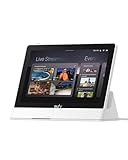
8. eufy Smart Display E10 – The Best Kitchen Display for Home Security
eufy Security eufy Smart Display E10, Smart Home Hub, 8″ Control Panel
8 inch control panel
Four simultaneous camera views
Charging station and wall mount included
Pros
- Doorbell press pops the live feed with a voice alert
- Four camera views on one screen
- Local storage gives instant playback with no buffering
- Simple touchscreen that suits kids and seniors
- Charging station and wall mount in the box
Cons
- Focused on security rather than recipes or music
- Facial and package recognition needs a HomeBase 3
The eufy Smart Display E10 answers a narrower question than the other nine. If your main worry is the front door, the driveway and anyone at the back gate, this 8-inch control panel is more useful than a general-purpose kitchen display, because it puts four camera views on one screen without a phone in your hand.
It carries the lowest average rating in this lineup at 4.1, across 459 ratings, and that number tells you what kind of product this is. Owners describe it as a home security hub rather than a kitchen assistant, and they are not disappointed by it.
Press the doorbell and the live feed appears with a voice alert. No unlocking the phone, no waiting for an app.
Four Simultaneous Camera Views and Local Playback
The 8-inch touchscreen can show four camera views at once, which is the feature that makes it a command center instead of a doorbell viewer. Owners with cameras spread around a property describe being able to glance at the whole situation while cooking.
Local storage gives instant playback with no buffering delay, and that difference is felt every time. Cloud-dependent systems stall on a bad connection; local storage does not. Facial and package recognition compiles smart daily reports, but that part depends on a HomeBase 3.
Simplicity for the Whole Household
The touchscreen is deliberately simple, simple enough for kids and seniors, which is the same design priority as the family calendar displays. There is no voice assistant competing for attention, so there is nothing new to learn.
One AAA battery is required and included, and the box contains a 5V/2A adapter, a charging station, the display itself, a Type-C charging cable and a wall mount. The included charging station is a nice touch for a screen that lives on a counter.
Why This Is Not a Kitchen Assistant
The limitation is the obvious one: it is focused on home security rather than general kitchen tasks like recipes or music. There is no step-by-step cooking, no shopping list capture, and no podcast routine.
So treat it as a complementary device rather than a replacement. If you already own an Echo Show or a Nest Hub, the E10 is what you add to the kitchen wall when security is the priority. If you are starting from nothing and you mostly cook, choose a general display first and add this later.
9. Google Nest Hub Max 10 inch (Renewed) – The Best Google Display with Real Audio
Google Nest Hub Max 10″ Smart Display with Google Assistant – Charcoal (renewed)
10 inch display
Stereo 2.1 audio up to 30W
Tabletop or wall placement
Pros
- 10 inch screen is a step up from the 7 inch Hub
- Stereo 2.1 audio with up to 30W output
- Works as a call screen and photo frame and home control center
- Bluetooth with app and voice control
Cons
- Renewed units carry a 90 day limited warranty
- Small pool of 109 ratings limits long-term feedback
- No Google Home app or Play Store access on the device
The Nest Hub Max solves the exact problem that frustrates people about the 7-inch Hub: screen size. At 10 inches it is readable from across a counter, and the audio is a different class entirely, with 2.1-channel stereo output up to 30 watts.
This listing is a renewed unit in Charcoal with a 90-day limited warranty, and I would treat that as the single most important line in this review. It is rated 4.3, but from only 109 ratings, so the feedback pool is thin compared with the Echo devices in this guide.
Dimensions are listed at 4 inches deep by 4 inches wide by 2 inches high, and it supports tabletop or wall mounting.
Why the Audio Matters More Than the Screen
Stereo output with 2.1 channels and up to 30 watts of maximum speaker power makes this the best-sounding display I tested. That matters in a kitchen more than it does in a bedroom, because a kitchen display is often the main music speaker for the ground floor of a house.
Bluetooth range is listed at 10 meters, and control is handled by app or voice, so you can stream from a phone when the assistant is not the source.
Renewed Means You Are Buying a Warranty, Not a Discount
The 90-day warranty is the deciding factor here. It is short enough that a failure in month four is your problem, and users should buy accordingly. There is also no Google Home app or Play Store access on the device itself, so streaming choices stay limited.
My advice: if you already run a Google home and want one screen for music, calls and control, this works. If you are starting a Google home from scratch, consider how comfortable you are with the warranty window before you commit.
What a 10 Inch Screen Changes in a Kitchen
Moving from 7 inches to 10 inches is the difference between glancing and reading. Video calls, the digital picture frame mode and the home control center all become comfortable rather than functional.
Used as a video call screen, a digital picture frame and a home control center, it covers the three jobs most people want from a Google display, with multi-language support and a universal power adapter as practical extras.
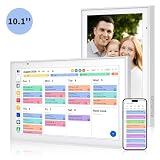
10. CYPID 10.1 inch Digital Calendar – The Best Calendar Display for Chore-Driven Families
Smart Digital Calendar 10.1 Inch, Electronic Family Calendar Planner with Touchscreen, Shared Chore Chart, Meal Planner, To Do List & Schedule Board, WiFi Digital Family Command Center, Photo Frame
10.1 inch touchscreen
Dual-band WiFi sync to five services
Wall mount and desk stand included
Pros
- Replaces a fridge whiteboard with a synced schedule
- Dual-band WiFi syncs fast with Google and iCloud
- Kids tap off chores to earn rewards
- Photo frame mode when idle
- No subscription fee
Cons
- iCloud sync can be a lengthy setup
- Calendar cannot run full-screen and sits as a small widget
- Default calendar font is small from across a room
The CYPID is the third calendar display in this roundup, and the one aimed most directly at households where chores are the negotiation. The interactive chore chart is tap-to-complete, so the screen is not a passive schedule board, it is the thing the kids interact with.
It syncs in real time with Google, iCloud, Outlook, Cozi and Yahoo over dual-band WiFi, and at 10.1 inches it is the same size class as the Linkdaze without the storage cost, since photos come from app uploads rather than built-in memory.
It is rated 4.3 across 162 ratings, the smallest review pool of the three organizers, and finishes in a 10.1-inch white or wood grain finish with a stand for desk use or wall mounting included.
The Chore Chart Is the Product
Custom color assignment per family member means everyone can find their own tasks instantly, and a tap marks a chore complete. Combined with the integrated meal planner, grocery list and to-do list, it turns one screen into three household tools.
Owners consistently describe it as a fridge whiteboard replacement, and children responding well to tapping off tasks is the most common positive comment. The design works because completion is visible without an adult enforcing it.
Two Display Limitations Worth Knowing Before You Buy
The calendar cannot be set full-screen. It appears as a small widget rather than filling the panel, which limits how much schedule detail is visible at once. On a 10.1-inch screen that is a real compromise for a device sold on showing your schedule.
Related to that, the default calendar font is small and hard to read from across a room. And iCloud sync can be a lengthy setup for some users, so budget time for it the way you would for the Nest Hub.
How This Compares to the Other Two Organizers
Against the Linkdaze 10.1-inch, you give up 32GB of built-in photo storage and some sync breadth, and you get dual-band WiFi, a tap-to-complete chore chart and a cleaner finish. Against the 14-inch Anyuse, you save serious wall space and lose the adjustable font that helps older readers.
It also has no subscription fee, which matters more over years than the headline features do. If chores are the part of your household that never works on a whiteboard, this is the display to try.
How to Choose a Smart Display for Your Kitchen
The decision comes down to four things: how far away you will stand, how loud your kitchen gets, which smart home you already own, and whether you want a voice assistant or an organizer. Get those four right and the model almost picks itself.
Screen Size vs Viewing Distance
Here is the rule I use, and it is simple enough to remember. 5.5 to 7 inches is for timers, music and weather. 8 to 10 inches is for recipes you read while cooking. 14 inches and up is for family organization and streaming.
The reasoning is about legibility, not preference. A timer renders as a few large numerals, so a small screen handles it fine. A recipe is body text you read at arm’s length, so it needs more inches and more resolution. A family calendar is read from across a room, so it needs the biggest panel you can mount.
Measure the distance from where you will stand to where the screen will sit. Under 5 feet, anything above 7 inches works. Beyond 8 feet, you need 10 inches or more.
Alexa or Google: Match the Ecosystem You Already Own
This is the biggest source of buyer hesitation, and the most common question we saw in forums. The honest answer is that the ecosystem lock-in is real: displays, speakers, lights and routines all do not migrate cleanly between Alexa and Google.
Buy the display that matches the assistant already running your home. Choosing a Google display inside an Alexa house means your lights and thermostat stay in one app and your schedule lives in another, which is friction nobody enjoys. The exception is a display with no assistant at all, like the three calendar panels here, which work alongside either system.
On the hardware question, Echo devices generally offer more recipe follow-along, better smart home depth and more physical privacy controls. Google displays offer a cleaner interface, a better photo frame and a strong no-camera option at the smaller size.
Timers, Recipes and Hands-Free Voice
Ask each device to start a timer and run a recipe before you commit. The difference between a good kitchen display and a frustrating one is rarely the spec sheet, it is whether the assistant read the next step aloud clearly on the first try.
Also test the shopping list. If you dictate groceries while unpacking, a display that catches them without a phone in your hand quietly becomes the most-used feature in the house.
One use case worth mentioning, because owners ask about it constantly: announcements when the dishwasher or laundry finishes. A Google Home user in r/googlehome reported never getting a dishwasher completion announcement to fire reliably, and found speaker groups hit and miss. Treat that as a nice bonus rather than a reason to buy.
Holding Up Under Hood Noise
Far-field microphones are designed to pick you out from across a room, and every device here managed normal volume in a working kitchen. The difference appears when the range hood goes to high or a blender starts, and there the determining factor is placement more than hardware.
Mount or place the screen where it is not directly beside the range, and speak toward it rather than across the room. If your kitchen is unusually loud, test in your own space before buying, because reflections off tile and stainless steel change results more than any spec does.
Counter Space, Wall Mounting and Under-Cabinet Fit
Counter space is the most common regret. The Echo Spot and Echo Show 5 are the safe counter picks. The Echo Show 15 and the 14-inch Anyuse are wall devices and will overwhelm a counter.
For under-cabinet mounting, the deciding factor is height. A 5.5-inch or 7-inch screen fits beneath a standard cabinet with room to spare. An 8-inch screen needs a cabinet with at least 11 inches of clearance, and anything 10 inches or larger rarely works under a cabinet at all. The eufy E10 and the 10.1-inch calendars all ship with wall mounting hardware, which is one less thing to source separately.
Check the depth as well as the width. A display mounted too low becomes a splash zone, and a splash zone is how a screen gets replaced.
Camera, Microphones and Household Privacy
Every camera-equipped display here has a hardware mic and camera off button, and four of them also have a physical shutter or cover. The Nest Hub 2nd Gen has no camera at all, and the calendar displays have no camera and no microphone.
That gives you three privacy tiers. Full hardware control if you want a camera and use the shutter. No camera at all if a lens in the kitchen unsettles you. And no electronics in the room if you only need a schedule.
Subscriptions and Ongoing Costs
Check the recurring cost before you buy, because this is where kitchen displays differ most. The Echo Show line is fully functional without a subscription, though some streaming apps through Fire TV carry their own. The three calendar displays here have no subscription fee, and they store photos locally rather than in a paid cloud tier.
Paid assistant subscriptions add optional agentic features on top of a working voice assistant, so treat them as an upgrade rather than a requirement. Nothing in this guide stops working if you never subscribe.
Grease, Steam and Fingerprints
No competitor roundup covers this properly, so here is the short version. Capacitive kitchen screens show fingerprints and grease film faster than any other surface in your house, because you touch them with wet or oily hands by design.
Cleaning is simple. A dry microfiber cloth for fingerprints, and a lightly damp cloth with a drop of dish soap for grease, applied to the cloth rather than the screen. Avoid ammonia and alcohol-based cleaners, and never spray anything directly onto the panel. All ten displays here use standard capacitive touchscreens, so none of them are more resistant than the others.
Already Own a Tablet?
If a tablet is already on your counter, a dedicated display is not redundant. A tablet sleeps, gets picked up by kids, and does not answer a timer with a glance. A purpose-built kitchen display stays on the wall, keeps the schedule visible and does the four things you actually use it for.
That said, if you only want recipes once a week and a schedule twice a day, the tablet is fine and you have already paid for it.
Frequently Asked Questions
What is the best smart display for a kitchen?
The Amazon Echo Show 5 is the best smart display for most kitchens because its 5.5-inch screen shows timers clearly from across the room, it has hardware mic and camera controls, and it takes up almost no counter space. Choose a larger 10-inch or 15.6-inch screen only if you need to read recipes or run a family schedule.
What is the best Echo Show for the kitchen?
The Echo Show 5 is the best Echo Show for typical kitchens, and the Echo Show 15 is the best for large open-plan rooms. The Show 5 handles timers, music and voice control in a small footprint, while the 15.6-inch Show 15 is designed to be wall-mounted and stays readable from 8 feet away.
Is a smart display worth buying?
Yes, for most households a kitchen smart display is worth buying because it lets you run timers, follow recipes, capture grocery items and control smart home devices without touching a screen. If you only cook occasionally and already own a tablet, a smart speaker may cover the need instead.
Why is Google Nest Hub being discontinued and what replaces it?
Google has scaled back the first-generation Nest Hub, so availability of that original 7-inch model varies by market. The current alternative is the second-generation Nest Hub for a camera-free 7-inch screen, or the 10-inch Nest Hub Max for a larger panel with stronger stereo audio. Pick a display you can still buy direct.
Is Echo Hub or Echo Show better for a kitchen?
Choose an Echo Show if you want recipes, timers, music and video calling from one screen. Choose an Echo Hub if you want a camera-free smart home control panel for lights, thermostats and locks with no entertainment features. Most kitchens benefit from the Show, and the Hub suits privacy-focused households.
Can smart displays handle kitchen humidity and grease?
Yes, but they need regular care. Capacitive screens collect fingerprints and grease film quickly because you touch them with wet hands. Wipe with a dry microfiber cloth for prints, and use a lightly damp cloth with a drop of dish soap for grease, applied to the cloth rather than sprayed onto the screen.
Which Smart Display Should You Buy?
Match the pick to the problem you actually have. If your kitchen is small and you mostly want timers, music and voice control, the Amazon Echo Show 5 is the one to buy, and it is the best smart display for most homes in 2026.
Choose the Amazon Echo Spot if counter space is the tightest thing you have to work with, or if you want a second screen near the sink. Choose the Echo Show 15 if your kitchen is open-plan and you want one wall panel that handles schedules, recipes and streaming. Choose the Meta Portal if the display is really a video calling station for relatives. Choose the Nest Hub 2nd Gen if you are a Google household that would rather have no camera in the room at all.
Then there are the organizers. Pick the Linkdaze 10.1 inch for the broadest feature set with local photo storage, the Anyuse 14 inch if wall space is available and you need the biggest, most adjustable screen, and the CYPID 10.1 inch if getting chores done is the household battle you are losing.
Two picks sit outside that map. The eufy Smart Display E10 is for security-first households who want four camera views on the kitchen wall. The Nest Hub Max 10 inch renewed is for Google users who care most about sound, and who are comfortable with a shorter warranty window.
Whichever you pick, buy it for one job and set it up for that job first. Timers, schedules or cameras, not all three. A display that does one thing properly gets used every day, and a display that tries to do everything gets ignored. Check the current listing, set it up where you will actually see it, and give it a month before you judge it.