
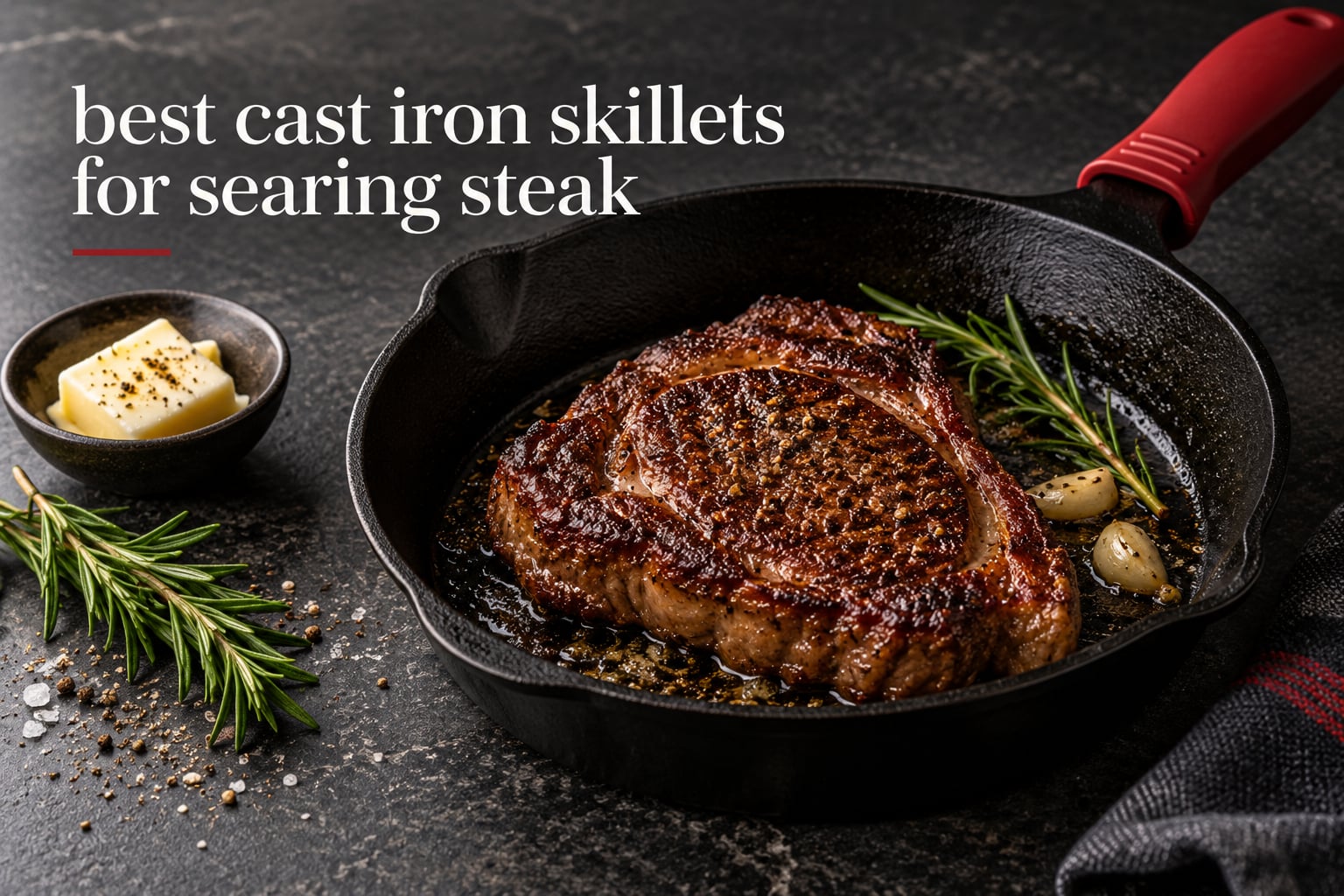
The Lodge Pre-Seasoned Cast Iron Skillet with Silicone Handle Holder, 12 Inches is the best cast iron skillet for searing steak, because its 7.5 pound body holds searing heat when a cold, wet steak hits the surface and keeps feeding that heat back while the meat cools the pan down. A thick pan is the whole game: the crust forms in the first ninety seconds or it does not form at all.
I have been chasing that crust for years, mostly by ruining steaks. The pan gets blamed for what is really a technique problem, so this roundup ranks ten cast iron skillets on searing duty alone rather than on eggs, cornbread or value for money. The criteria that matter are the empty weight, the flat cooking surface diameter, the surface finish, and whether you can lift the thing while it is full.
Two things get skipped in most cast iron roundups and both of them decide whether your steak is good. The first is pan size matched to steak cut, because a 12 inch pan cannot give a 10 ounce filet proper contact. The second is bare versus enameled, the single most argued question on r/castiron and the top organic result for this whole search. I answer both below.
Everything in this guide is updated for 2026, and every weight, dimension and rating quoted here comes from the manufacturer listing and owner reviews rather than from spec sheet guesswork.
Our Top 3 Best Cast Iron Skillets for Searing Steak (October 2026)

Lodge 12 Inch Pre-Seasoned
- 7.5 lb thermal mass
- Induction ready
- Silicone handle holder
- PFAS-free seasoning

Comparing All 10 Skillets on Weight, Surface and Sear Duty
| Product | Specs | Action |
|---|---|---|
| Lodge 12 Inch Pre-Seasoned Skillet |
|
Check Latest Price |
 Lodge 12 Inch Dual Handle Pan Lodge 12 Inch Dual Handle Pan |
|
Check Latest Price |
| Utopia Kitchen 12 Inch |
|
Check Latest Price |
 Victoria 12 Inch Cast Iron Skillet Victoria 12 Inch Cast Iron Skillet |
|
Check Latest Price |
 Cuisinel 12 Inch Covered Set Cuisinel 12 Inch Covered Set |
|
Check Latest Price |
 Stargazer 12 Inch Stargazer 12 Inch |
|
Check Latest Price |
 Field Company No.10 Field Company No.10 |
|
Check Latest Price |
 Lodge Blacklock 12 Inch Lodge Blacklock 12 Inch |
|
Check Latest Price |
 Greater Goods 12 Inch Greater Goods 12 Inch |
|
Check Latest Price |
 Mercer Culinary 10.25 Inch Mercer Culinary 10.25 Inch |
|
Check Latest Price |
1. Lodge Pre-Seasoned Cast Iron Skillet, 12 Inch – the Best Overall Steak Pan
Lodge Pre-Seasoned Cast Iron Skillet with Silicone Handle Holder, 12 Inches
7.5 lb empty weight
1.89 L capacity
260 C max temperature
Induction compatible
Pros
- Heavy 7.5 lb body resists temperature drop
- Even heat distribution with no hot spots
- Pre-seasoned with 100 percent natural vegetable oil
- Silicone handle holder included
- Made in the USA
Cons
- Awkward to lift one-handed when full
- Hand wash and re-oil needed to hold the seasoning
This is the pan I hand to people who ask me what to buy. At 7.5 pounds empty it is not the heaviest thing in the list, but the mass is concentrated in the base and walls where searing needs it, and owner reviews describe heat distribution as even with no hot spots. A 4.7 average across more than 21,000 ratings is a data point in itself, because it means thousands of people have watched a steak brown on this surface for years.
The 1.89 liter capacity gives you real room for a 1.5 inch ribeye plus room to turn it without the edge hanging over the wall. Cooking surface capacity is listed in liters rather than a square-inch figure, so treat that as a guide rather than an exact contact area.
Why Thermal Mass Decides the Sear
The reason this pan wins has nothing to do with brand. When a 20 degree ribeye hits iron at searing temperature, the surface of the pan drops hard. A thin pan drops below browning range instantly and the meat sits there steaming in its own juice until the liquid cooks off. A 7.5 pound casting stores enough energy to recover within seconds, so the crust starts forming the moment contact happens and keeps forming across the whole face of the steak.
That is also the honest counterargument to buying a bigger pan. Weight only helps if you can control it. This pan needs two hands and a silicone holder on a loaded sear.
Surface Finish and Factory Seasoning
The interior is a pre-seasoned as-cast surface coated with 100 percent natural vegetable oil, and it is PFAS-free. Out of the box it is not the glassy surface you get from a machined premium pan, so give it two or three cooks before you judge it, and re-oil while it is still warm.
Handling, Cooktops and Heat Limits
Compatible with smooth surface induction, gas and electric coil, and rated to 260 degrees Celsius. Care is hand wash only, which is the correct rule for bare cast iron anyway. The round shape and cast iron handle plus the red silicone holder are the combination that keeps a full pan off your knuckles.
Reddit cooks routinely call a Lodge the indestructible workhorse, and the community consensus on r/castiron is blunt: a plain 10 inch Lodge sears well because the iron is thick and retains heat, and honestly any cast iron pan will do the job. That consensus is why this one takes the top slot here rather than something more expensive.
2. Lodge Pre-Seasoned Cast Iron Dual Handle Pan, 12 Inch – Best Rated, Easiest to Move
Lodge Pre-Seasoned Cast Iron Dual Handle Pan, PFAS-Free, 12 Inches
3 kg empty weight
2.1 L capacity
Dual assist handles
Gas and induction ready
Pros
- Highest rated at 4.8 across 22000+ reviews
- Dual loop handles make a loaded pan manageable
- Even heating with no hot spots
- Works on stovetop
- oven
- grill and campfire
- PFAS
- PFOA and PTFE free
Cons
- Still substantial weight with a full pan
- Seasoning needs occasional refreshing to stay nonstick
If the single-handle Lodge feels awkward, this is the fix, and it is the highest rated skillet in the group at 4.8 with 87 percent of reviews at five stars. Two cast iron loop handles on a 12 inch pan change the physics of a sear. You can lift it off the burner, turn it, and move it into the oven without the tilt-and-hope maneuver a one-handled pan demands.
Multiple reviews describe searing steaks as a primary use case, which is a good sign for anyone shopping this specific page. The 2.1 liter capacity is the largest listed in this roundup, and it is the one to pick if you are cooking a porterhouse or two steaks in a single pass.
Why the Dual Handle Changes Sear Handling
Weight is the most repeated complaint across cast iron reviews, and 12 inch pans commonly land in the 7 to 8 pound range before food. Add a 1.5 inch steak and you are moving close to 10 pounds of awkward, unbalanced load off a burner. Two handles spread that load and keep the pan level, which matters because a tilted pan lays the steak against one wall and strips heat from the other side.
The honest caveat from the reviews: a minority note that the heft remains significant even with two handles. This solves the grip problem, not the weight problem.
Heat Distribution and Hot Spots
Owner reviews describe stable, even heating with no hot spots, and that is the property that matters most after total mass. A hot spot under a steak browns one side while the other stays grey. A pan that heats evenly lets you stand at the burner and flip on time rather than chasing the cooking surface around.
Seasoning and Versatility
Traditional iron-and-oil finish, no synthetic coating to flake. Reviews do note the seasoning needs refreshing with occasional oiling to stay nonstick, which is a ten second job with a paper towel while the pan is warm. Compatibility runs electric coil, gas and smooth surface induction, and the pan works on a grill or over a campfire.
3. Utopia Kitchen Cast Iron Skillet 12 Inch – Best Value for a Big Flat Sear
Utopia Kitchen Cast Iron Skillet 12 Inch Pre-Seasoned PFAS-Free Black
3.44 kg empty weight
450 F max temperature
Gas cooktops
12 inch flat bottom
Pros
- Largest review pool in the roundup at 27000+ ratings
- Strong heat retention and even distribution
- Large flat 12 inch bottom suits family portions
- Lowest cost per pan among the 12 inch options
- Bakes cornbread well
Cons
- Pebbled surface rather than machined smooth
- Factory seasoning is thin and often wiped off in packaging
- Rougher interior edges can catch delicate foods
This is the one most people end up owning, and with 27,397 ratings averaging 4.5 it has the largest review pool of anything in this roundup. At 3.44 kg it is a genuinely heavy pan with a wide flat bottom, and reviews describe consistent performance for steaks, cornbread and one-pan meals. The value case is simply that you get a lot of iron for very little money.
I include it rather than burying it because a large flat bottom is the most underrated searing feature there is. Crust forms through contact, and a wide flat base gives a whole ribeye more contact than a sloped-walled pan with the same rim diameter.
Heat Retention on a Budget Casting
Heat retention is the standout in owner reviews, and at 3.44 kg the pan is the third heaviest here. That mass is why it can hold a searing temperature through a cold steak without waiting to recover. Lightweight pans in this list trade away exactly this, and it is the trade people notice on the first thick cut.
The listed maximum temperature is 450 degrees Fahrenheit, which is the lowest ceiling in the roundup. That is fine for stovetop searing, and it is a reminder that a cast iron pan rated at 500 or 1000 degrees is giving you more oven headroom for finishing a thick cut.
The Pebbled Surface Problem and How to Fix It
The dominant complaint is a pebbled, bumpy interior rather than a machined smooth one, and the factory seasoning is thin enough that most owners re-season before first use. Expect sticking for the first few cooks and read it as seasoning, not as a defective pan. The rough edges catch delicate food more than a smooth plane does, which barely matters for a steak and matters a great deal for scallops.
Two or three cycles of a thin high smoke point oil layer in a hot oven will close the gaps and give you the release the reviews describe later on.
Cooking Surface and Portion Size
The flat and circular 12 inch base is the argument for this pan, and reviews confirm it handles family-sized portions in one pass. Listing compatibility is gas, so if you run induction check the variant before buying. Hand wash only, same as everything else bare in this roundup.
4. Victoria 12-Inch Cast Iron Skillet – Best for a Fast Preheat and Thin Steaks
Victoria 12-Inch Cast Iron Skillet, Pre-Seasoned Cast-Iron Frying Pan with Long Handle, Made in Colombia
6.7 lb empty weight
1000 F max temperature
Induction compatible
Helper handle
Pros
- Thin casting heats up quickly for a fast hot sear
- Long curved handle grips better than a short helper handle
- Two drip-free pour spouts
- Limited lifetime manufacturer warranty
Cons
- Textured surface rather than machined smooth
- Lighter duty feel than heavier 6 to 7 lb castings
Every other heavy pan in this list asks you to wait. Victoria asks less. At 6.7 pounds with a thinner casting profile, it comes to searing temperature faster than a deep foundry pan, and owners who are impatient during a weeknight cook cite exactly that as the reason they bought it.
The 4.6 average across 12,038 reviews with 80 percent at five stars is solid, and the long curved handle is the most distinctive design choice in the roundup. It gives you a full-length grip on a pan that would otherwise need a helper handle. The trade-off is real: you give up some thermal mass, and that is the entire bargain.
Thin Casting and Quick Response
A thinner pan is not automatically better, it is just faster. It responds quickly to flame changes, which makes it easier to control a sear and much easier to rescue a steak that is going too dark. It also cools faster once the steak lands, so you will want the steak dry and very close to room temperature so the temperature drop costs you less.
For a thin strip steak or a petite filet, where the cook time is short, that responsiveness is an advantage rather than a compromise.
Handle, Spouts and Versatility
The signature long curved handle is praised by owners for giving a better grip than the short helper handles found on many competing pans, and the deep vessel with a thicker edge plus drip-free spouts on both sides make it easy to move juices without a mess. Compatible with smooth surface induction, and it works on stove, oven, campfire and grill. Rated to 1000 degrees Fahrenheit, the highest listed ceiling here.
Textured Surface and Warranty
The surface is textured rather than machined smooth, which reviewers note is a little less forgiving for delicate food than premium milled pans. For a ribeye sear that difference is marginal. The limited lifetime manufacturer warranty is a genuine plus, and this pan has been manufactured in Victoria’s own Colombian factories since 1939.
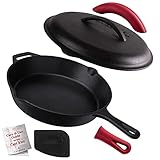
5. Cuisinel Cast Iron Skillet with Lid, 12 Inch – Best Set for Sear Then Baste
Cuisinel Cast Iron Skillet with Lid – 12″-inch Pre-Seasoned Covered Frying Pan Set + Silicone Handle & Lid Holders + Scraper/Cleaner – Indoor/Outdoor, Oven, Stovetop, Camping Fire, Grill Safe Cookware
7 lb empty weight
2 quart capacity
500 F oven safe
Induction compatible
Pros
- Skillet
- cast iron lid
- silicone grips and scraper in one box
- Heavy-duty even heat for high heat searing
- Lid turns the pan into a braiser for basting
- Silicone handle and lid holders included
Cons
- 7 lb weight is heavy when lifting a full pan
- Lid adds bulk for storage
Read the specs on a 4.7 with 85 percent five stars and you would assume a single pan. This is a set, and the box contains a 12 inch skillet, a matching cast iron lid, a silicone handle holder, a lid grip and a pan scraper. For a steak specifically, the lid is the reason to care. Once you have seared, you drop butter in the hot pan, put the lid on, and let the steak finish basting in the oven instead of standing there turning it.
That workflow is how you cook a thick ribeye without tearing the crust. It is also why this set is worth the extra pieces even though you will use the lid for maybe two dishes a month.
Sear, Then Lid and Baste in the Oven
The heavy-duty even heat distribution is praised for high heat searing, and at 7 pounds the mass is right where you want it. A 500 degree Fahrenheit oven rating gives you room to finish a 2 inch steak to medium rare after a two minute sear per side, which is the technique most people struggle with on a stovetop alone.
Drop a knob of butter, tilt the pan so it pools on the hot side, rest the steak against that side, cover, and return to a 375 degree oven. Twenty minutes of unattended basting beats twenty minutes of hovering.
What Comes in the Box
Skillet, 12 inch cast iron lid with drip points, pan scraper, silicone handle holder and grip holder. The scraper is genuinely useful for getting the fond off after a sear without stripping seasoning, and the silicone holders solve the hot handle problem that burns people on other pans.
Weight and Storage
Weight is the main drawback at 7 pounds, and the set is bulkier to store than a bare skillet. Compatibility covers electric coil, gas and smooth surface induction, and the seasoning is natural oil and PFAS and PFOA free.
6. Stargazer 12-Inch Cast Iron Skillet – Best Machined Smooth Surface
Stargazer 12-Inch Cast Iron Skillet | Made in USA, Seasoned, Premium Frying Pan for Grilling, Searing, Baking & More – Durable Cast Iron with Smooth Cooking Surface
6.5 lb empty weight
3.4 quart capacity
Induction compatible
Lifetime warranty
Pros
- Machined smooth surface releases far better than pebbled iron
- Flat wobble-free base with no casting imperfections
- Extended stay-cool handle grips with a dish towel
- Flared rim pours cleanly from any angle
Cons
- One report of a warped bottom on the 13.5 inch size
- Heavier than lightweight iron and needs a longer preheat
The machined cooking surface is the whole pitch. A milled flat plane gives you more true contact with a flat-cut steak than an as-cast pebbly floor does, and owners coming from Lodge report food releasing far better on this surface. One long-form review benchmarks the finish against vintage Wagner and Griswold pans, which is the standard I would use to judge a smooth iron.
At 4.6 across 515 reviews with 84 percent five stars, the rating is strong but the volume is small next to the Lodge and Utopia numbers. Read it as a well-liked pan with a much smaller sample, not as a proven one.
Machined Surface and True Contact
Searing is a contact problem. A ribeye is not perfectly flat, and every ridge in the pan floor is a place where meat touches air instead of iron. A machined surface closes that gap, which shows up as a more uniform crust colour and a steak that releases when you decide to turn it rather than when it decides to let go.
It is the clearest reason to spend more on cast iron for steak, and for thin cuts like strip or filet the difference is more visible than it is on a thick ribeye.
Base, Rim and Handle
The round shape with a flat base and flared rim is praised for a wobble-free bottom with no casting imperfections out of the box, and the flared rim pours from any angle without a dedicated spout, which matters when you are spooning pan juices over a resting steak. The extended stay-cool handle can be gripped with a dish towel, addressing the single most common burn complaint in cast iron reviews. Induction compatible, with a lifetime warranty against manufacturing defects.
Preheat Time and the One Flaw
At 6.5 pounds with a thick base, this pan needs a longer preheat than a thin casting. Budget your time accordingly. The one specific defect reported is a warped bottom on the 13.5 inch size, which is a different size from this one, so weigh the report without treating it as a verdict on the 12 inch. Available in 10.5, 12 and 13.5 inch, made in the USA.
7. Field Company No.10 Cast Iron Skillet – Best Lighter Premium Cast
Field Company No.10 Large Cast Iron Skillet – 11.6-Inch Pre-Seasoned Pan for 4+ Servings, Lighter & Smooth, Made in USA
6 lb empty weight
9.75 inch flat surface
Three coats grapeseed oil
Made in USA
Pros
- Machine-polished surface modelled on vintage American cast iron
- Lighter than a traditional 12 inch foundry pan
- 9.75 inch flat surface gives solid crust contact
- Made in USA from remelted scrap iron
Cons
- Lowest average rating in the group at 4.3
- 7 percent one-star reviews
- more than the other premium pans
This is the interesting one. At 6 pounds it is 1.5 pounds lighter than the standard Lodge 12 inch, and the 9.75 inch flat cooking surface gives a thick steak genuine contact without the total mass you would normally sacrifice for that. The machine-polished surface is modelled on vintage American cast iron rather than on modern production iron.
It is also the lowest rated product in this roundup at 4.3, with 7 percent one-star reviews. The critical reviews are less about defects than about expectations, with some owners reporting more sticking and inconsistency than the premium tier suggests. I would still put it on the shortlist, but I would not hand it to a first-time cast iron owner as a no-brainer.
The Weight to Contact Ratio
Here is the most useful framing in this roundup. Heavy pans are not automatically better, and lighter pans are not automatically worse. What matters is mass per square inch of cooking surface. The Field Company No.10 spreads 6 pounds across a 9.75 inch flat plane, so a good portion of the pan is metal instead of rim, which is exactly the metal that stores heat where the steak touches it.
Compare that to a sloped-sided 12 inch pan where much of the weight sits in walls you never touch during a sear. The lighter premium cast can hold heat through a steak with less total mass than a heavier, sloped design.
Dimensional Detail Worth Knowing
The published measurements are 11 and 5/8 inches rim to rim, 9 and 3/4 inch flat cooking surface, 16 and 1/2 inches overall length with the handle, and a 2 and 1/8 inch wall height at 6 pounds. That 9.75 inch flat area is the number to check against your steak. A 1.75 inch thick ribeye at 16 ounces needs real surface, and this is one of the reasons the 12 inch nominal size still works.
Seasoning, Manufacturing and the Rating Gap
Pre-seasoned with three coats of organic grapeseed oil, works on all cooktops including glass and ceramic induction, and the seasoning is described as developing over time with use. It is made in the USA from green sand castings using remelted scrap iron with zero-waste sand cycling, and it is ISO certified. The 4.3 average is the honest counterweight, and the 7 percent one-star share is worth factoring in if you are risk averse.
8. Lodge Blacklock 12 Inch – Best Lightweight Lodge for Grip Concerns
Lodge Blacklock 12 Inch Lightweight Cast Iron Skillet
2.54 kg empty weight
Triple seasoned
25 percent lighter than standard Lodge
Made in USA
Pros
- About 25 percent lighter than a standard Lodge skillet
- Triple seasoned for a natural nonstick finish
- Elevated raised handle stays cooler longer
- Made in USA with PFOA and PTFE free material
Cons
- Thin-walled casting gives up some deep heat retention
- Sloped sides offer less wall height for basting
Weight is the most repeated complaint in cast iron reviews, and for people with grip or wrist problems it is not a preference, it is a safety question. At 2.54 kg the Blacklock is listed as 25 percent lighter than a traditional Lodge skillet, and owners consistently note it is easier to move one-handed during a sear. That is a meaningful difference in a pan you have to lift while full.
The 4.4 average across 498 reviews with 75 percent five stars is solid for a secondary line. What you are buying is a lighter pan that still comes from a foundry with a name you recognise, and the raised handle is the detail reviewers like most during a long cook.
What You Give Up by Going Lighter
Heat retention is more mixed on this one, and some find the thin-walled casting stores less heat than a heavy foundry pan. Be honest about that trade: the lightness that makes it easy to lift is the same lightness that means the pan recovers from a cold steak a little slower. If you are searing thin strips and quick cuts, that is a fine bargain. If you are cooking a cold two inch ribeye, the heavier pans in this list will give you a more forgiving margin.
Triple Seasoning Out of the Box
Triple seasoning is credited with a natural nonstick finish and simple cleanup, which means fewer of the first-cook sticking problems that make new owners think the pan is faulty. The finish is nontoxic and PFOA and PTFE free, and it is made in the USA. Round shape with sloped sides, which is the reason basting is less convenient than on a straight-walled pan.
Who This Pan Is Actually For
If you cook one or two steaks at a time, have any wrist or grip trouble, or live in a small kitchen where a 7 pound pan is genuinely awkward to manoeuvre off a burner, this is the Lodge to buy. Compatibility covers gas, oven, grill and open flame.
9. Greater Goods 12 Inch Cast Iron Skillet – Best Milled Surface Without the Boutique Price
Greater Goods 12″ Cast Iron Skillet, Smooth Surface, Nonstick-Like Release
7.8 lb empty weight
3.2 quart capacity
Precision-milled surface
Helper handle
Pros
- Precision-milled smooth surface at a mid-tier price
- Pre-seasoned with organic flaxseed oil
- No synthetic coating to peel or wear away
- Roomy 12 inch surface for four burgers in one batch
Cons
- Underside can be rough and may need sanding on glass tops
- Shipping seasoning can be uneven and needs extra layers
Stargazer owns the machined surface crown in this roundup, and this is the answer for people who want that same release without the boutique tier price. The 12 inch surface is precision-milled with no synthetic coating, and at 4.4 across 1,704 reviews with 75 percent five stars it has a much larger sample than most of the premium picks here.
Buyers frame it as an affordable path to a milled-smooth cooking plane, and reviews note the seasoning improves noticeably with use once the pan is properly re-seasoned. That last clause matters, because arrival condition is the recurring complaint.
Milled Surface and the Seasoning Reality
At 7.8 pounds this is the heaviest pan in the roundup, which means the slowest preheat and the best temperature recovery once it is hot. The milled surface gives you the contact of a premium iron and the flaxseed oil seasoning is described as releasing food from the first meal, with a real improvement as the seasoning builds.
Expect to do one extra seasoning layer before the first steak. Reviews flag that the shipping seasoning is sometimes uneven or sticky, and that fixes itself after a cycle in a hot oven.
Handles, Spouts and the Glass Top Warning
The 5.5 inch primary handle plus helper handle and dual pour spouts improve control on a loaded pan. The one real warning is the underside, which reviewers say can be rough and may need sanding before use on a glass cooktop. That is a five minute job with fine sandpaper and it prevents a permanent scratch. Compatible with gas, electric coil and smooth surface induction. Not made in the USA, which a small group of buyers prefers otherwise.
10. Mercer Culinary Pre-Seasoned Cast Iron Skillet, 10.25 Inch – Budget Pick for First-Time Owners
Mercer Culinary Pre-Seasoned Cast Iron Skillet, 10.25-Inch
2.41 kg empty weight
10.25 inch cooking surface
Induction, gas and electric
Lightweight for its size
Pros
- Lowest cost entry point to cast iron in the roundup
- Light at roughly 5.3 pounds and easy to move
- Assist handle plus main handle with hanging hole
- Pre-seasoned with natural vegetable oil
Cons
- Rough porous surface sticks more than a smooth-milled pan
- One-piece handle gets very hot during use
This is the pan to buy if you have never cooked on cast iron and you do not want to spend real money finding out whether you like it. At 2.41 kg it is the second lightest 12 inch class pan here, and the 10.25 inch cooking surface diameter is the smallest listed, which suits a single 10 to 12 ounce steak far better than a 12 inch pan would.
Owners report cooking thousands of steaks on it without degradation, which tells you more about cast iron as a material than about this specific brand. At 4.4 across 1,513 reviews with 76 percent five stars, it is a proven entry point rather than a risky one.
Why a Smaller Pan Can Sear Better
A 10.25 inch pan puts more of its mass in contact with a single steak. Searing needs metal under the meat, and a smaller pan concentrates the metal where the food is. The trade is capacity: this is a one steak pan, not a pan for a ribeye plus a side of vegetables.
It is also the pan in this roundup that most easily answers the objection that cast iron is too heavy, at roughly 5.3 pounds empty.
Surface Texture and the Hot Handle
The most common complaint is the coarse, porous cooking surface, which sticks more than a Lodge or a machined pan. On a steak that is manageable if you dry the surface, use a high smoke point oil and leave the meat alone for the full sear. The one-piece cast iron handle gets hot fast, so plan on a holder or a folded towel rather than bare fingers.
Compatible with smooth surface induction, gas and electric, and available in 8, 10.25 and 12 inch plus multi-size sets. Care is simple: hand wash, dry thoroughly, light oil while warm.
Which Skillet Size Matches Which Steak Cut
Nobody maps steak cut to pan size, and it is the question people ask most often after they buy. The rule is simple: the flat cooking surface should be wider than the steak, with an inch of bare iron on at least one side so you can slide a spatula underneath to turn it without tearing the crust.
Filet, 8 to 10 Ounces
A filet is small, round and thick, and the risk is not lack of contact, it is the tenderloin falling apart when you turn it. A 10.25 inch pan like the Mercer Culinary is more than enough surface, and the tighter pan makes the flip easier because you have room to get a spatula all the way under the meat. A 12 inch pan works fine and simply leaves more bare iron.
New York Strip and Sirloin
These are long and relatively thin, and they need a long axis of contact. A round 12 inch pan handles a strip laid diagonally with room on both ends. This is the everyday case, and it is the reason a 12 inch pan is the most common answer to what skillet size is best for a ribeye.
Ribeye, 16 Ounces and Up
A bone-in ribeye is the widest common steak and the one most often under-served by a small pan. You want the full 12 inch class here, which is why six of the ten pans in this roundup are 12 inch. If your ribeye is over 1.5 inches thick, you also want a pan with enough wall and enough oven headroom to finish it, which is where the 500 degree rated pans earn their place.
Porterhouse and Two Steaks at Once
Porterhouse is a size problem, not a technique problem. Published capacities in this roundup run from 2.1 liters on the Lodge dual handle up to 3.2 quarts on the Greater Goods and 3.4 quarts on the Stargazer. If you regularly cook for four or want two sears in one pan, capacity is the spec to compare first.
Bare vs Enameled Cast Iron for Searing: The Verdict
The top organic result for this entire search is a Reddit thread asking whether to use raw or black enameled cast iron for searing. The short answer is bare cast iron wins, and the reason is physical rather than sentimental.
Every pan in this roundup is bare, seasoned cast iron. That is not an accident of the selection process, it is the answer to the question. Enameled cast iron is a glass-like vitreous coating, and a coating is always a compromise between release and maximum heat tolerance. Bare seasoned iron gives you a surface that tolerates far higher heat before anything smokes or degrades, and it polishes smoother with years of use. Reddit cooks reach the same conclusion, with the community verdict that raw is for searing and enameled is acceptable only if you oil the pan before cooking.
The Three Downsides of Enameled Cast Iron
Chipping does not heal. Once enamel chips, bare iron is exposed and that spot can no longer be re-seasoned the way a seasoned surface can. It becomes a rust and sticking risk in the middle of your cooking surface.
Lower heat ceiling in practice. Many enamel recipes cap the oven temperature, which limits how aggressively you can finish a thick cut.
No seasoning to build. Enameled pans do not develop a patina, so there is no long-term performance curve. Bare iron gets better for decades.
What Not to Cook in Enameled Cast Iron
Keep enameled pans for acidic sauces, tomato-based dishes, slow braises and anything where a nonreactive surface matters. That is exactly what enamel is good at. For a steak sear, the bare surface is the tool for the job, and no seasoning kit changes that.
How to Sear Steak in Cast Iron Without Ruining the Crust
The pan matters, but technique decides the result. This is the routine I use, and it works in any of the ten pans above.
Step 1: Preheat Longer Than Feels Necessary
Set the burner to high and give the pan a full ten minutes, more for a 7 pound foundry casting. You are not waiting for smoke. You are waiting for the metal itself to reach searing temperature, and a light haze or a faint shimmer of oil flicked on the surface is your signal. A widely repeated technique in the community is to preheat in a 500 degree oven first, then finish the preheat on the stove, which gets a heavy iron to temperature faster.
Step 2: Choose a High Smoke Point Oil
Use grapeseed oil, avocado oil or canola for the sear. Butter burns at searing temperature, so it goes in after the crust forms, not before. Olive oil is a poor choice for a hard sear because it smokes well before browning range. A thin film is all you need, and it should shimmer rather than smoke.
Step 3: Dry the Steak and Salt It Ahead
Surface water is the enemy of crust. It has to evaporate before browning can start, and every drop costs you temperature and adds steaming. Pat the steak dry, then salt it at least 40 minutes ahead of cooking if you can. Pre-salting is the most commonly cited technique upgrade in owner discussions, and it seasons the meat all the way through rather than only seasoning the surface. Bring the steak closer to room temperature than feels comfortable, because a cold steak costs the pan more heat.
Step 4: Lay It Down and Leave It Alone
Place the steak away from you so the handle does not jerk when the meat hits. Press it flat for ten seconds to guarantee full contact, then do not touch it. Two to three minutes per side for a two inch steak is the common benchmark, and the reason most steaks stick is not the pan, it is pulling too early or a surface that was not hot enough. If the crust is releasing when you are ready to turn, the pan is doing its job.
Step 5: Baste in Butter at the End
Add a knob of butter, tilt the pan, and spoon the foaming butter over the steak while it rests on the hot side. This is the aroma and flavour step, and it happens after the crust already exists, so the butter never burns into the crust.
Step 6: Rest Before Cutting
Rest the steak on a board for five to ten minutes. Cutting early dumps the juice you just created, and the crust goes shiny and wet instead of staying crisp.
Oven Finishing a Thick Cut
For anything over 1.5 inches, sear two to three minutes per side on the stovetop, then move the pan into a 375 to 400 degree oven. Thick cuts in pans rated to 500 or 1000 degrees give you more room to finish. Use an instant-read thermometer in the side of the steak and pull it at 125 to 130 degrees for a medium rare finish, then rest it. Under the reverse sear method, cook the steak low and slow to about 10 degrees below your target, then sear it hard for 90 seconds per side in the preheated pan.
How We Scored These Pans for Searing
Most cast iron roundups rank on eggs, cornbread and value. This one ranks on steak. Five things decided the order, and every number in this guide comes from the manufacturer listing or owner reviews rather than from a spec sheet.
Empty Weight as the Thermal Mass Proxy
Mass is the reason a pan holds temperature, and empty weight is the only figure every listing publishes. The range here runs from 2.41 kg on the Mercer to 7.8 pounds on the Greater Goods, with the standard Lodge 12 inch at 7.5 pounds and the Field Company No.10 at 6 pounds.
Flat Cooking Surface Area
Contact makes the crust. The Field Company publishes its flat surface directly at 9 and 3/4 inches, and the Mercer lists a 10.25 inch cooking surface diameter. For the rest, the pan size and the base shape tell the story, and a wide flat bottom beats a narrow one with a big rim.
Surface Finish
Machine-polished surfaces release better and brown more evenly than as-cast pebbly ones. Stargazer, Field Company and Greater Goods are milled. Lodge, Utopia, Victoria, Cuisinel, Blacklock and Mercer ship as-cast surfaces that get smoother with seasoning.
Temperature Recovery
This is where design shows up. Deep walls and a thick base store more energy. A sloped-sided or thin-walled pan responds faster and stores less. Neither is wrong, it depends on whether you sear one thick steak or four thin ones.
Handling While Loaded
Two handles beat one, a helper handle beats nothing, and a raised or stay-cool handle beats a flat one that cooks your hand. This is where the Blacklock and the dual handle Lodge earn their rankings, and it is the criterion owners mention most often after weight.
Buying Guide: Nine Decisions Before You Buy a Steak Skillet
Match the Pan to the Cut You Actually Cook
Buy the size you will use most. A 10.25 inch pan is a better sear for a single 12 ounce strip than a 12 inch pan is, because more of the metal sits under the meat. A 12 inch is the answer for ribeye, porterhouse and feeding more than two people. Check the flat cooking surface, not the rim diameter, if the manufacturer publishes it.
Decide How Much Weight You Can Actually Lift
Be honest here. A pan that is too heavy to control will not produce a better crust, it will produce a dropped steak and a burned hand. For grip or wrist concerns, the Blacklock at 2.54 kg and the Mercer at 2.41 kg are the two lightest options in this roundup. The dual handle Lodge solves the problem differently, by giving you two points of contact on a 12 inch pan.
Decide Whether Smooth or Pebbled Matters to You
A machined surface browns more evenly and releases more reliably, and it matters more for thin cuts, fish and delicate food than for a thick ribeye. A pebbly as-cast surface is more forgiving once seasoned and costs far less. If you have never owned cast iron, the cheap pebbly pan will teach you the same technique for a fraction of the outlay.
Plan for the Seasoning Reality
Every pre-seasoned pan in this roundup will still benefit from a re-seasoning before serious use, and reviews across several of them specifically mention thin, uneven or sticky factory seasoning. The break-in is three cycles: scrub, dry, coat with a thin layer of grapeseed or flaxseed oil, and bake. After that the pan only improves. What ruins cast iron seasoning is soap-heavy washing, a dishwasher, leaving it wet, and acid sitting on the surface.
Check the Handle Before the First Cook, Not After
The most common injury in cast iron is a burned hand on the handle. Look for a helper handle on 12 inch pans, a raised handle, or plan on a holder. The Lodge 12 inch ships with a silicone holder, Cuisinel includes both handle and lid grips, and the Stargazer handle is designed to be gripped with a dish towel.
Confirm Cooktop Compatibility
Most of these pans are smooth surface induction compatible, which covers induction, glass and ceramic. The Utopia Kitchen listing names gas only, so verify the variant if you run induction. If you use a glass cooktop, sand a rough underside before the first use so you do not scratch it permanently.
Check the Oven Ceiling If You Finish Thick Cuts
Victoria is listed to 1000 degrees, Cuisinel to 500, Utopia Kitchen to 450, and the Lodge 12 inch to 260 degrees Celsius, which is 500 Fahrenheit. All of those handle a 375 to 400 degree finish for a thick steak, but a higher ceiling gives you a wider finishing window when you are reverse searing.
Decide How Much You Care About Where It Was Made
Several picks are made in the USA, including both Lodges, Stargazer, Field Company and the Victoria line is manufactured in Colombia since 1939. The Field Company pan uses green sand castings and ISO certified processes. Where a pan is cast changes the finish tolerance, not the physics of searing, so treat this as a preference rather than a performance spec.
Remember the Pan Is Not the Whole Answer
Cast iron versus carbon steel versus stainless is the biggest debate in the community, and carbon steel has real advocates for steak, particularly for anyone who wants a lighter pan. A carbon steel paella pan is a legitimate searing tool. Cast iron wins on thermal mass and on being oven safe without any assembly, which is what makes it the easiest path to a good crust for a home cook. Stainless is the middle ground, lighter than iron but with less stored heat, and nonstick is the right answer for a weeknight pan where crust matters less than cleanup. If you want a second steel pan for steak prep and prep work, our guide to steak knife sets for dinner parties covers the tools that come before the pan.
Frequently Asked Questions
What is the best oil to use to sear steak in a cast iron pan?
Use a high smoke point neutral oil such as grapeseed, avocado or canola for the sear itself, applied as a thin film that shimmers rather than smokes. Butter belongs after the crust has formed, not before, because it burns at searing temperature. Olive oil is a poor choice for a hard sear because it smokes well before browning range.
What type of pan is best for searing steaks?
For home cooks, a thick bare cast iron skillet is the best pan for searing steaks, because its thermal mass holds searing heat when a cold steak hits the surface and the crust forms immediately. Carbon steel is lighter and also excellent. Stainless steel sits in the middle with less stored heat, and nonstick is the choice when easy cleanup matters more than crust.
How long do you sear a 2 inch thick steak in cast iron?
Two to three minutes per side on a fully preheated pan, pressing the steak flat for the first ten seconds and leaving it completely undisturbed after that. For a 2 inch steak, finish in a 375 to 400 degree oven until an instant-read thermometer hits 125 to 130 degrees for medium rare, then rest five to ten minutes before cutting.
Is enameled cast iron good for searing steak?
Bare cast iron is better for searing. Enamel is a glass-like coating that chips without healing, caps your practical oven temperature, and never develops the patina that makes bare iron improve over decades. The community verdict in r/castiron is the same: use raw cast iron for searing, and keep enameled pans for acidic sauces and slow braises.
What are the downsides of enameled cast iron?
The three real drawbacks are that chips expose bare iron that cannot be re-seasoned, that many enamel pans carry a lower oven temperature limit which limits aggressive finishing, and that enameled surfaces never build a patina, so there is no long-term performance gain. Enamel is also more expensive for what it offers on a high heat sear.
What ruins cast iron seasoning?
Heavy dish soap, the dishwasher, leaving the pan wet after washing, and cooking acidic foods like tomato sauce or vinegar on the surface. Dry the pan on the burner, wipe on a paper towel, and add a thin layer of oil while it is still warm. A scrubber or chain mail is fine, steel wool is only for stripping a pan you intend to re-season from scratch.
The Bottom Line on Cast Iron for Steak in 2026
If you want one pan for everything, the Lodge 12 inch with the silicone handle holder is the best cast iron skillet for searing steak in 2026. Its 7.5 pounds hold heat through a cold ribeye, its seasoning is PFAS-free, and the holder solves the hot handle problem. If lifting a loaded pan is the part that stops you, take the Lodge Blacklock at 2.54 kg or the dual handle Lodge if you want the 12 inch surface without the balance problem.
If your priority is a flawless crust on a thin cut, the Stargazer 12 inch or the Greater Goods 12 inch give you a machined surface that browns evenly. If you want the most metal under the steak for the least money, the Utopia Kitchen 12 inch has the biggest review pool in this roundup. And if you just want to find out whether you like cooking on cast iron, the Mercer Culinary 10.25 inch is the cheapest way to find out.
Whichever one you pick, dry the steak, preheat the pan for a full ten minutes, and do not touch the meat for the first two minutes. That routine does more for your crust than the difference between any two pans on this list. Pick your size, season it properly, and start searing.